
PRODUCT CASE STUDY · HRTECH · B2B2C SAAS
Recruitment,
reimagined.
Building a connected AI-powered recruitment and career platform for job seekers and hiring teams.
Explore JobBox ↗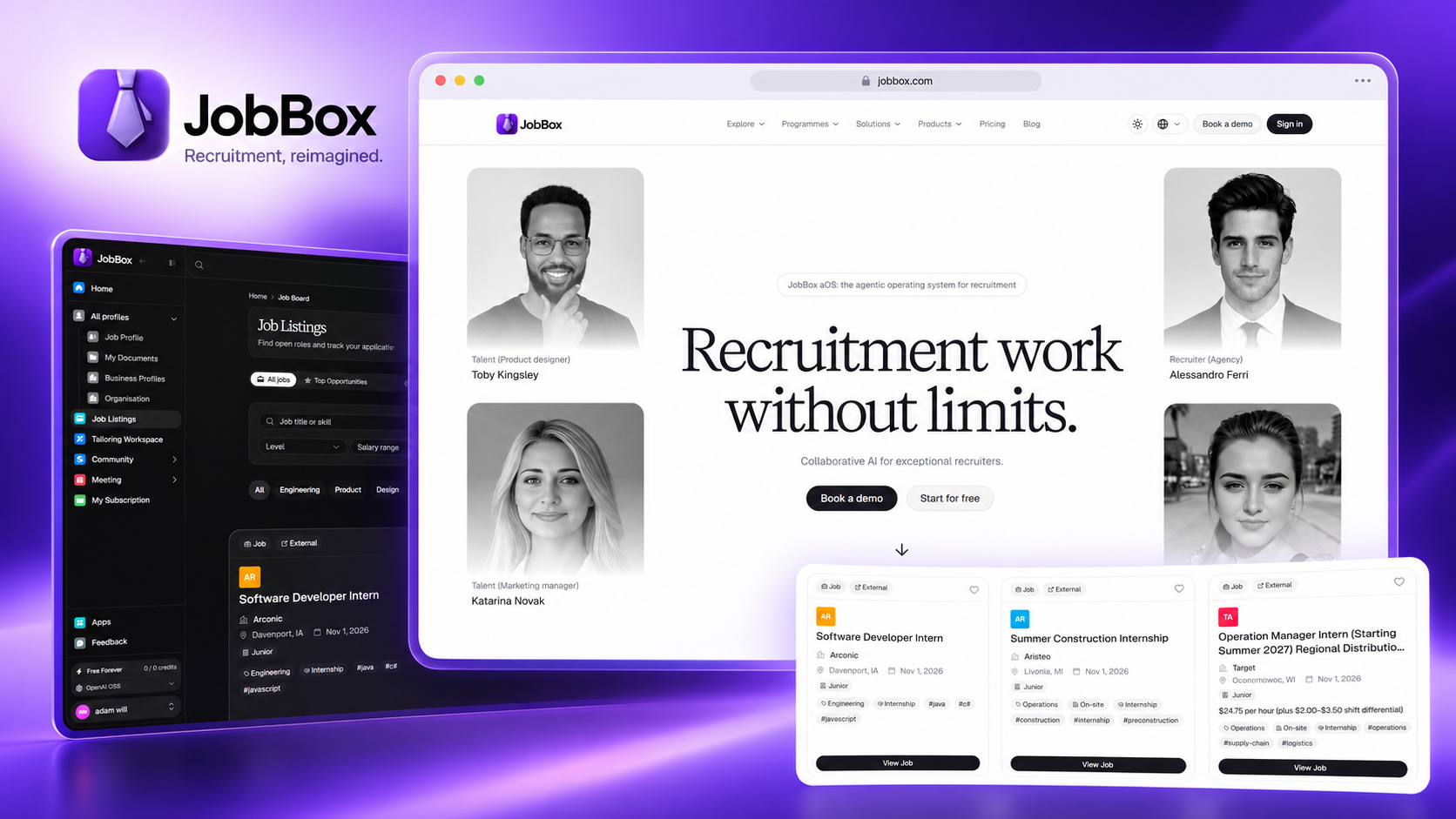
PROJECT OVERVIEW
One platform for two sides of the hiring journey.
JobBox is an AI-powered recruitment and career platform designed to connect job seekers with relevant opportunities while helping recruiters streamline candidate assessment and recruitment workflows. It brings job discovery, AI-assisted matching, CV tailoring, interview preparation, AI-led interview assessments, and psychometric testing into a connected experience.
As Product Manager, I worked across product definition, requirements gathering, user experience, AI feature development, assessment design, quality assurance, and cross-functional delivery. My focus was to translate the product vision into functional requirements, ensure that features addressed real user needs, and validate that the implemented experience worked as intended.
These are JobBox-level figures reported in the project brief, not outcomes attributed solely to my individual work. Definitions and reporting periods should be confirmed against the analytics source.
THE CHALLENGE
Recruitment was fragmented for candidates and recruiters.
Finding a job and finding the right candidate are connected challenges, but people approach them with different needs. Job seekers can spend hours searching, rewriting applications, and preparing for interviews without understanding which roles fit. Recruiters need to work through applications, compare evidence, and assess candidates while managing multiple vacancies.
Too much effort, too little clarity.
- Relevant roles are difficult to discover across fragmented sources.
- One CV rarely highlights the right evidence for every application.
- Structured, role-specific interview practice can be hard to access.
- Candidates need a clearer view of how their profile fits a role.
More applications, limited signal.
- Manual screening takes time, especially across multiple vacancies.
- Inconsistent criteria make candidate comparisons harder.
- Role-specific skills and judgment need structured assessment.
- Jobs, applications, and assessment workflows can live in separate tools.
Create one connected recruitment and career-support experience: help candidates find and prepare for suitable opportunities while giving recruiters tools for structured candidate discovery and assessment.
USERS & JOURNEYS
Design for the candidate and the hiring team.
JobBox is a two-sided product. The experience needed to give each group clear value while keeping their journeys connected through job requirements, candidate profiles, applications, and assessments.
Job seekers
Recent graduates, experienced professionals, career changers, and people exploring new opportunities.
- Create an account and share career information.
- Discover roles and understand match relevance.
- Tailor application materials to an individual opportunity.
- Prepare for interviews and complete relevant assessments.
Recruiters and employers
HR professionals, talent acquisition specialists, hiring managers, and employers filling open roles.
- Define a vacancy and its requirements.
- Find and review potentially suitable candidates.
- Configure role-specific assessments where useful.
- Use structured candidate information to support decisions.
MY ROLE
From product intent to a validated experience.
I connected product objectives with requirements, user experience, implementation, and quality assurance. That meant looking beyond feature delivery to understand the intended user outcome, define expected behaviour, identify usability risks, and validate what the team shipped.
Strategy & planning
Translated product vision into actionable feature scope for candidates and recruiters; clarified how features fit into the wider platform.
Requirements
Defined user flows, functional expectations, assessment objectives, and feature behaviour so design and engineering could build toward a shared outcome.
AI product definition
Connected job matching, CV tailoring, AI-led interviews, and psychometric assessments to specific user problems and usable workflows.
UX & workflow design
Mapped journeys and reviewed interactions, with attention to clarity and unnecessary complexity in recruiter and assessment administration tasks.
Cross-functional delivery
Worked across product, design, and engineering to communicate requirements, review implementation, and resolve issues found during testing.
Quality assurance
Tested core user journeys, documented inconsistencies, and verified that reviewed functionality matched intended requirements.
FEATURE DEEP DIVES
Product decisions across the hiring lifecycle.
Each capability addressed a distinct point in the recruitment journey. I worked on the product definition, workflow, requirements, assessment structure, or validation described below.
01AI-assisted job matchingCandidate discovery
Help people find roles that fit the evidence in their profile.
Job seekers can struggle to identify opportunities aligned with their skills and experience; recruiters also need efficient ways to find potentially suitable candidates. JobBox uses AI-assisted matching to connect candidate profiles with job requirements.
My contribution: I contributed to product definition and the intended matching experience, considering the relationship between candidate information, role requirements, and the job-discovery journey.
Product intent: more relevant discovery, better alignment between profile and role requirements, and a more focused search. Match quality depends on profile data, job-description quality, and the matching methodology.
02AI-powered CV tailoringApplication preparation
Help candidates emphasize relevant experience for a specific role.
Reusing the same CV for every application can make it harder for candidates to communicate the experience and skills that matter for an individual opportunity. JobBox’s CV-tailoring capability connects a candidate’s existing information with a target role.
My contribution: I helped define the feature’s purpose and place in the application journey, with the goal of making the assistance useful and grounded in the candidate’s real qualifications.
Product guardrail: support candidates in expressing genuine experience clearly; do not introduce skills or experience they do not have.
03Quest AI interview assessmentsStructured evaluation
Make assessment objectives and criteria specific to the role.
Unstructured interviews can make it difficult to evaluate candidates consistently against job-specific competencies. Quest AI supports interview assessments configured around a role, its requirements, and evaluation criteria.
My contribution: I worked on assessment objectives, scenarios, and evaluation rubrics. One example was configuring an assessment for Registered Nurse candidates.
Nursing competency areas: clinical judgment; patient safety; recognition of deterioration; care prioritization; medication safety; communication and teamwork; ethical conduct; and infection prevention and control.
Product considerations: scenarios should be role-relevant and understandable; evaluation criteria should be interpretable by recruiters and reviewed for consistency, relevance, and potential bias. For regulated roles, AI assessment complements verification of qualifications and credentials.
04Psychometric assessmentsAssessment design & administration
Organize assessment content so it is usable for candidates and administrators.
CVs and interviews may not show every relevant reasoning or judgment skill. The assessment concepts explored included numerical, verbal, and logical reasoning; pattern recognition; situational judgment; and attention to detail. I also worked on simple multiple-choice numerical-reasoning formats.
My contribution: I worked on assessment structure, question formats, categories, and requirements for managing content. I identified that the original administration flow was more complicated than necessary and proposed a clearer table-based management experience.
Assessment quality: useful results depend on relevant questions, clear objectives, a sound scoring method, and appropriate validation—not simply the presence of an AI feature.
05Authentication & account accessCore platform access
Validate the door into the product.
JobBox supports email, Google, and LinkedIn authentication, plus password recovery. If users cannot sign in or regain access, they cannot reach job discovery or recruitment workflows.
My contribution: I tested sign-up and login flows, checked that password-reset emails arrived and enabled password changes, and identified a visual inconsistency in Magic Link information.
Resolution: the Magic Link information was specified to use yellow rather than red to match the intended meaning. The documented core authentication and password-reset flows passed testing after identified issues were resolved.
PRODUCT REQUIREMENTS
A portfolio summary of the product requirements.
This section organizes the requirements described in my project notes into a concise product brief. It summarizes the work and user journeys; it is not a verbatim internal PRD.
Make the hiring journey more accessible, structured, and efficient with AI-assisted recruitment technology.
B2B2C SaaS serving job seekers and recruiters.
Product objectives
- Improve job discoveryHelp candidates identify opportunities aligned with their skills, experience, and career goals.
- Support better applicationsHelp candidates tailor application content to a specific opportunity.
- Improve interview preparationProvide access to interview preparation and structured assessment experiences.
- Support recruiter efficiencyHelp organize hiring work and evaluate candidates against role requirements.
- Build a reliable product experienceValidate key journeys and support ongoing use of the platform.
Functional requirements reflected in the project
Allow people to create and access an account using email, Google, or LinkedIn; support password recovery and confirm the reset path.
Allow candidates to review roles and provide AI-assisted matching that relates profile information to job requirements.
Let candidates use existing profile information and a target opportunity to prepare role-relevant application content without inventing qualifications.
Allow recruiters to define job requirements and review potentially suitable candidates in the hiring workflow.
Support role-specific objectives, scenarios, and rubrics that recruiters can interpret and use as one input to evaluation.
Organize categories and questions; give administrators a table-based view with clear actions to manage categories and assessment content.
Provide administrative reporting and product-activity tracking. Interpret metrics using their defined event, period, and user definitions.
Review implemented behavior against intended flows; document functional, visual, and workflow issues and verify resolution.
Acceptance criteria summarized from documented flows
- Candidate authentication works for each supported method, and password recovery completes from email receipt through password change.
- Candidate and recruiter journeys expose actions appropriate to each user group.
- Matching links candidate profile information with role requirements; match explanations must not imply more certainty than the underlying method supports.
- CV assistance preserves the candidate’s actual skills and experience.
- Recruiter assessments can be configured around the role and its competencies, with evaluation criteria available for review.
- Assessment categories and content can be managed through clear, centralized actions.
- Reported analytics retain clear definitions and are not presented as feature-level causal impact without supporting evidence.
- Issues found during QA are tracked to resolution and the reviewed flow is checked again.
CHALLENGES, DELIVERY & QA
Resolve the workflow, then validate the whole journey.
Psychometric administration felt more complicated than it needed to be.
Assessment management is a repeated administrative task. Extra navigation and unclear actions can slow routine work and increase opportunities for mistakes.
My response: I proposed a table-based management interface: an administrator creates a category, sees it in a table, and uses row actions to edit or upload relevant content. This centralizes category management in a more understandable workflow.
Outcome: the identified workflow issues were resolved and the administration experience was aligned with the intended requirements.
Authentication needed end-to-end validation.
I checked email, Google, and LinkedIn sign-up and login, along with forgot-password, reset-email delivery, password changes, and Magic Link information presentation. I identified and clarified the intended yellow treatment for the Magic Link information.
Outcome: identified authentication issues were resolved, and the documented authentication and password-reset flows passed testing.
Candidate assessments needed clearer structure.
I worked on assessment categories, question formats, role-specific interview scenarios, and evaluation rubrics. The goal was to connect the role’s needs to the candidate scenario and the criteria used to interpret responses.
Outcome: assessment workflows were aligned with the intended requirements. Their usefulness still depends on relevance, consistency, and appropriate validation.
How I approached product QA
AuthenticationEmail, Google, and LinkedIn sign-up/login; reset email delivery; password change; Magic Link feedback.
AssessmentsCategory organization, question and content management, admin-flow complexity, role-specific objectives, and evaluation criteria.
ExperienceUser-flow clarity, requirement-to-build consistency, visual treatment, and opportunities to remove unnecessary interaction steps.
The project brief states that issues identified through the documented review and testing process were resolved. No issue count or test coverage percentage was supplied.
MEASUREMENT & OUTCOMES
Use metrics with context.
JobBox has administrative reporting through Admin and Super Admin interfaces, alongside integrated Google Analytics for product activity. The project brief reports the platform figures below.
These are platform-level results reported for JobBox, not metrics attributable exclusively to one product change or to my individual contribution. Direct causal attribution would require feature-level analytics, a before-and-after comparison, or a controlled experiment. Definitions and periods should be checked against the source reporting.
How my work connected to product outcomes
Authentication validation supported reliable account access. Matching and CV-tailoring requirements shaped the job-discovery and application-preparation experience. Quest AI and psychometric work added structure to assessment workflows. Simplifying assessment administration addressed usability. QA connected requirements to implemented behavior.
REFLECTION
What JobBox reinforced for me.
Functional is not always usable.
A task can be possible and still feel unnecessarily difficult. Repeated admin workflows deserve the same product attention as customer-facing features.
AI needs a clear job to do.
Matching, CV tailoring, and interview assessments need distinct inputs, outputs, and evaluation criteria because each solves a different problem.
Structure matters in assessment.
Role relevance, clear objectives, and consistent criteria matter as much as the interface or AI capability.
QA is product work.
Testing checks whether the delivered experience matches the intended requirements and gives teams a concrete path to fix issues.
Metrics need definitions.
Adoption and uptime are useful signals, but sound decisions depend on consistent tracking and a shared meaning for each metric.
Two-sided products need balance.
Job seekers and recruiters have distinct needs, and product decisions should account for how their experiences affect one another.
MY PRODUCT PRINCIPLE
Understand the problem.
Make the requirements clear.
Validate what we ship.
NEXT PROJECT
Kate Stone Prep↗