
PRODUCT CASE STUDY · AI · SALES AUTOMATION · B2B SAAS
Turn early
conversations into
qualified next steps.
Defining an AI-powered sales platform that helps businesses engage prospects, qualify opportunities, and connect promising conversations to their sales workflow.
Explore SONA ↗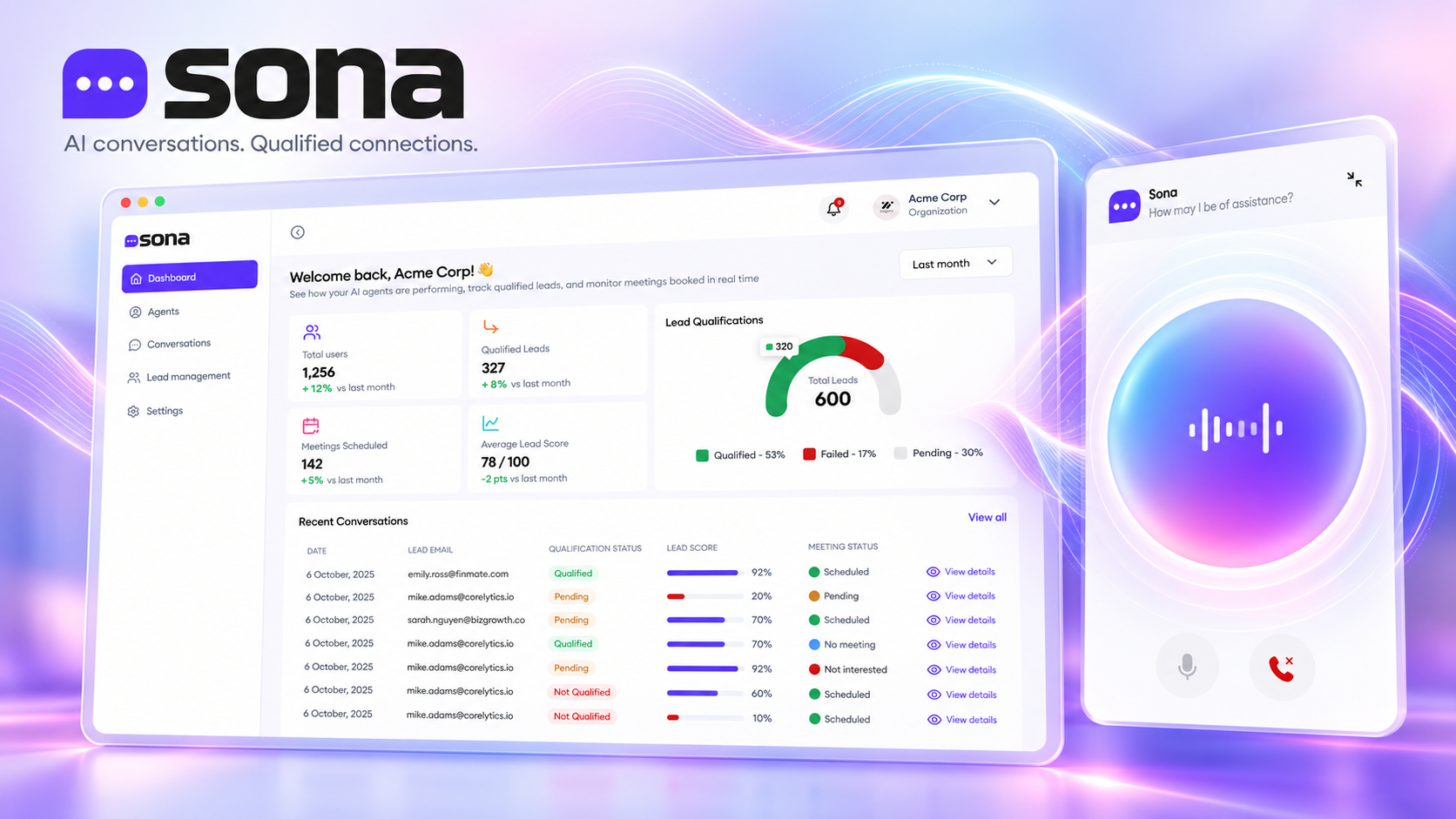
PRODUCT OVERVIEW
A connected system for the first stages of sales.
SONA AI is a conversational sales and lead-qualification platform for businesses. It enables organisations to create AI agents for inbound website conversations and outbound email engagement. Agents can answer questions using organisation-provided information, gather prospect context, apply qualification rules, and support a meeting or human handoff.
The product brings agent configuration, knowledge management, lead qualification, conversation and meeting management, CRM integrations, and analytics into one platform. The work moved the concept toward a functional MVP and pre-launch stage.
Use AI to support the sales team and reduce repetitive early-stage work, while keeping people involved in meaningful decisions and handoffs.
THE PROBLEM
More leads do not automatically mean more sales opportunities.
Businesses receive enquiries through their websites and marketing activity, and reach out to contacts through outbound sales. But early engagement can be slow, repetitive, inconsistent, and spread across tools. Sales representatives may spend time on prospects who are not ready or are not a fit, while qualified people wait for answers.
Delayed engagement
Website visitors may wait for a representative before getting useful information or a clear next step.
Inconsistent discovery
Different representatives can ask different questions, making lead assessments harder to compare.
Repetitive manual work
Initial outreach, follow-up, data capture, and meeting coordination can be difficult to manage at scale.
Fragmented context
Conversations, customer details, qualification outcomes, and sales activity may live in separate systems.
The product opportunity was to structure early engagement and qualification while preserving a clear route to human sales teams.
DISCOVERY & ROLE
Make the broad concept actionable for the team.
I drove product work from initial concept through product definition, planning, design coordination, development collaboration, and pre-launch preparation. Discovery focused on how businesses engage inbound enquiries, conduct outbound outreach, qualify prospects, maintain customer records, and schedule sales meetings.
Research areas
- Conversational AI and agent configuration.
- Knowledge-base management and Retrieval-Augmented Generation (RAG).
- Lead scoring, BANT qualification, and conversation workflows.
- CRM synchronisation, voice interactions, and third-party integrations.
- Role-based access, business administration, and responsible AI safeguards.
My responsibilities
- Define product vision, objectives, target users, scope, and MVP priorities.
- Write the PRD, functional requirements, user stories, and acceptance criteria.
- Map journeys and specify organisation dashboard and internal Back Office needs.
- Coordinate design and engineering, review product behaviour, and support QA.
- Prepare the product for pre-launch review and iteration.
A key discovery decision was to make agents configurable around each organisation’s information, product, pricing, policies, and sales instructions rather than depend on generic AI knowledge alone.
PRODUCT STRATEGY
Prioritize the core sales workflow before expanding channels.
The vision included inbound chat, outbound email, voice, CRM integrations, multichannel communication, and analytics. I structured the MVP around the essential path and grouped requirements so the team could see how capabilities connected.
Organisation & account
Accounts, team management, roles, permissions, and platform settings.
Creation & knowledge
Agent configuration, knowledge sources, channel setup, and controls.
Engagement & qualification
Inbound and outbound journeys, BANT logic, lead statuses, and follow-up.
Conversation & meetings
Conversation history, summaries, action items, and meeting management.
Integrations
CRM, email, knowledge storage, voice, and scheduling services.
Analytics & Back Office
Organisation reporting and separate internal platform administration.
AGENTS & KNOWLEDGE
Let organisations shape how their agents engage.
The agent-creation experience was defined around the organisation’s sales context and communication needs. Each agent can be configured with an identity, behaviour, knowledge, and channel appropriate to its role.
Ground responses in organisation context
Knowledge requirements cover company information, products and services, pricing, FAQs, policies, procedures, sales guidance, supporting documents, and website links. The RAG approach is intended to retrieve relevant organisation material when an agent responds, helping the conversation reflect the business’s context.
Response quality depends on useful source material, retrieval behaviour, answer presentation, and clear boundaries. Configurability needs to be understandable to business users and manageable over time.
CORE WORKFLOWS
Guide conversations from discovery to a useful next step.
Introduce the agent and establish the reason for the interaction.
Understand the prospect’s question, needs, and context.
Use relevant organisation information and clarify fit.
Collect signals against agreed sales criteria and assign a status.
Help suitable prospects move toward a meeting or human follow-up.
AInbound website engagementRespond and qualify
A visitor opens the business site, starts a conversation, asks a question, and receives an answer grounded in the organisation’s knowledge base. The agent gathers relevant context, applies qualification criteria, records the interaction and lead status, and supports a meeting or sales handoff when appropriate.
BOutbound email engagementPersonalize and follow up
The outbound workflow connects to relevant contact information, supports personalised outreach and prospect replies, asks qualification questions, manages follow-up sequences, suggests meetings when appropriate, records communication history, and updates lead status.
CLead qualification with BANTConsistent assessment
Qualification is structured around Budget, Authority, Need, and Timeline. The workflow gathers answers progressively, identifies needs and pain points, assesses the criteria, and supports Qualified, Not Qualified, or Pending statuses. The supplied product brief describes a threshold of at least three of four BANT criteria, alongside a broader lead-readiness target.
DConversation and meeting managementOperational visibility
Teams need conversation lists and detail views, text transcripts, voice records, summaries, lead status, internal notes, action items, email composition, and history. Meeting views cover booked, missed, and cancelled meetings, categories such as demos, feedback, and complaints, meeting details and summaries, with Calendly scheduling requirements.
PRODUCT REQUIREMENTS
Define the customer workspace and the internal control plane.
The PRD captured product objectives, user types, workflows, system behaviour, functional requirements, and business rules across two distinct environments.
For customer teams
- Create an organisation and manage team access.
- Create, configure, activate, and deactivate agents.
- Upload knowledge sources and connect CRM platforms.
- Monitor leads, conversation history, summaries, and statuses.
- Manage meetings, team roles, reporting, and account settings.
For SONA operations
- Manage organisations, subscriptions, and platform accounts.
- Administer internal users and agent oversight.
- Monitor platform activity and maintain audit logs.
- Support operations and data retention/deletion controls.
- Restrict internal functions to appropriate administrative roles.
Separating these environments is an architecture and permissions decision: customer teams manage their sales activity, while internal administrators manage platform-level operations.
Integrations identified
DELIVERY, TRUST & MEASUREMENT
Build the workflow with visibility and responsible boundaries.
I partnered with design and engineering to clarify requirements, review user flows and product behaviour, support agent and knowledge retrieval implementation, coordinate dashboard and Back Office work, review integrations, and participate in product reviews, QA, and pre-launch preparation.
Roles and controls
Define invitations, team roles, permissions, administrative restrictions, active/inactive team states, and audit-log needs.
Protect sensitive context
Requirements include avoiding collection of passwords, OTPs, and sensitive financial information, and respecting CRM consent and communication opt-outs.
Measure meaningful activity
Planned reports include total and qualified leads, qualification rates, conversation activity, meeting outcomes, team activity, and customer feedback trends.
Prepare for pre-launch
Review implementation against requirements, test core account and workflow behaviour, gather feedback, and refine alignment before launch.
No verified usage, conversion, revenue, or efficiency results were supplied for SONA. Analytics are described here as planned reporting requirements. The figures visible inside the supplied mockup are illustrative artwork and are not presented as results.
OUTCOMES & REFLECTION
A functional MVP foundation with the next stage clearly framed.
The documented outcomes are product direction, requirements, workflows, and implementation foundations. The product reached an MVP/pre-launch stage, with final testing and further alignment remaining part of delivery.
- Established product vision, target users, and MVP scope.
- Created product requirements and user stories for the organisation dashboard and internal Back Office.
- Defined agent creation, configuration, and organisation knowledge requirements, including RAG.
- Specified BANT-based qualification, inbound and outbound journeys, and lead statuses.
- Structured conversation and meeting management requirements.
- Identified CRM, communication, knowledge, voice, and scheduling integrations.
- Defined team administration, permissions, security, analytics, and operational requirements.
- Supported implementation of core agent creation and knowledge retrieval capabilities, voice-agent integration planning, administrative features, product review, and QA.
AI products need defined behaviour, relevant knowledge, qualification rules, and clear boundaries.
Automation should reduce repetitive work and support human decisions.
Integrations are part of the product experience, not an afterthought.
A broad vision needs a focused MVP that prioritizes the essential user workflow.
MY PRODUCT APPROACH
Translate an ambitious AI idea into clear users, workflows, requirements, and an MVP the team can build.
NEXT PROJECT
SwipeWise↗Back to all selected work