
PRODUCT CASE STUDY · AI · CUSTOMER SUPPORT · B2B SAAS
AI answers.
Human connection.
Defining an AI-powered support platform that answers common questions with business context, while preserving a clear path to a human when customers need more help.
Explore SupportBox ↗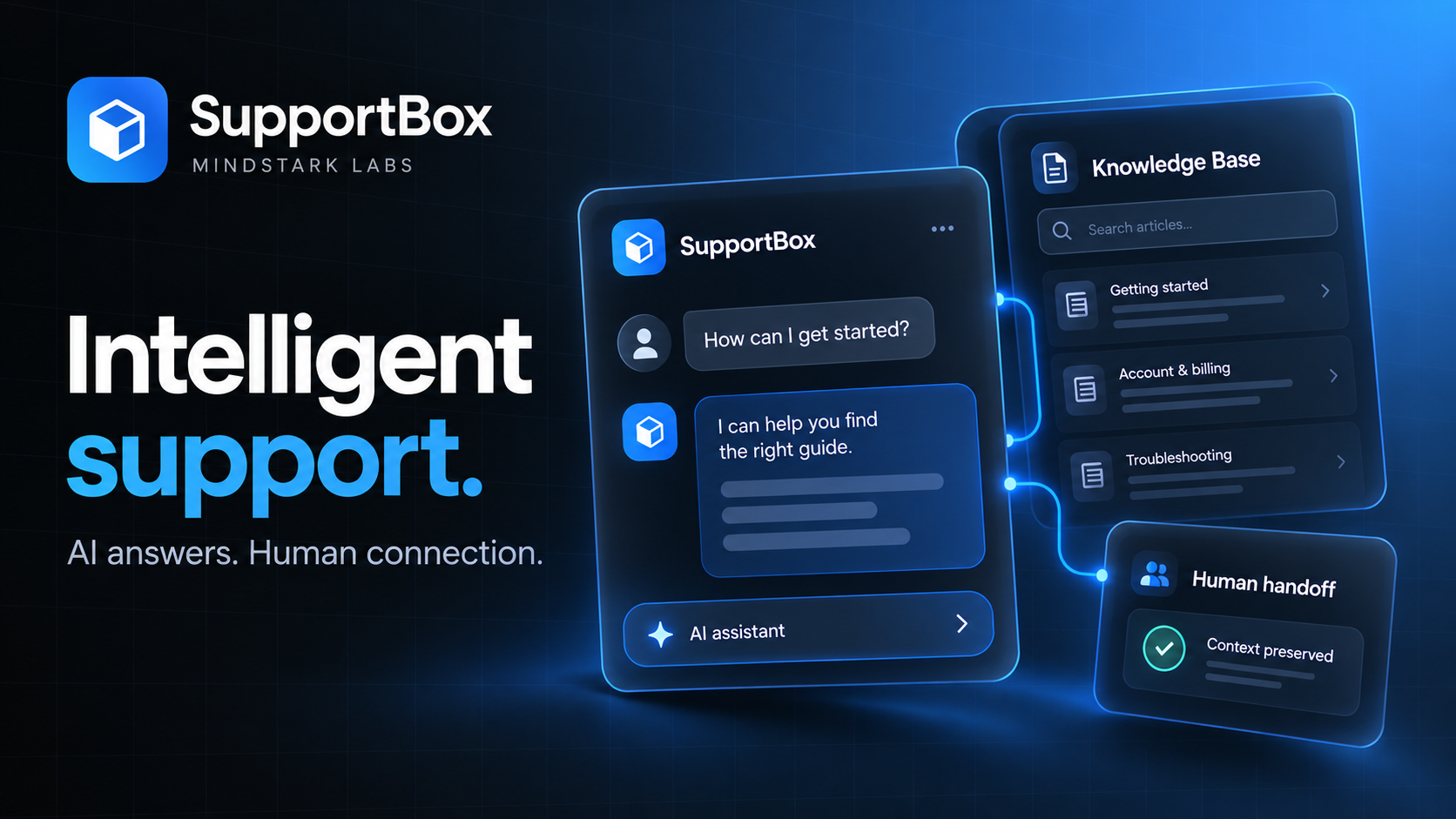
PRODUCT OVERVIEW
Automate the common questions and keep human help within reach.
SupportBox is an AI-powered customer support platform for businesses. It combines an AI support assistant, an embeddable website chat widget, knowledge management, and an administration dashboard. The product helps businesses handle repetitive enquiries with automated responses while enabling complex conversations to move to a human support representative.
My role was to help define and deliver the platform, connecting the business objective to the customer conversation, business configuration, and technical implementation.
Project-reported outcome from the supplied case study. The measurement method and reporting period were not provided, and the figure has not been independently verified.
THE CHALLENGE
Support teams repeat answers while customers wait for the right help.
Customer support teams can receive a high volume of enquiries across channels. Many questions recur, but not every issue is appropriate for automation. The product needed to shorten the path to useful information without trapping customers in a bot-only experience.
Frequently asked questions
Agents spend time repeating information that could be answered from approved business content.
Customers wait for help
A customer may need to wait for an available representative before receiving an initial answer.
Generic answers miss the business
Useful support depends on accurate company-specific policies, products, and guidance.
Some issues need a person
Complex or sensitive conversations should be recognized and transferred with context.
Businesses need control
Support teams need ways to configure the assistant and manage customer interactions.
Different clients, different setups
Multi-client delivery requires administrative controls for separate environments and configurations.
Build an AI-assisted support experience that retrieves business-specific information, automates common interactions, and gives the customer a route to human support when automation is insufficient.
USERS & PRODUCT SCOPE
Serve the customer conversation and the team behind it.
I defined the experience from two perspectives: a customer seeking help and the business responsible for providing that help. The widget needed to stay simple; the administration experience needed to give businesses practical configuration and oversight.
People asking for support
- Open the chat widget without leaving the business website.
- Ask a question and receive a clear, relevant response.
- Keep conversational context while continuing the interaction.
- Reach a human support representative when needed.
Support teams and platform operators
- Configure the support assistant and business knowledge.
- Manage conversations and operational settings.
- Review activity and oversee support operations.
- Manage clients and environments at scale.
Core product areas included AI-powered conversations, an embeddable widget, knowledge management, automation and handoff logic, administration, client management, analytics, security, and access controls.
CUSTOMER EXPERIENCE
A natural support flow, embedded in the business website.
The chat widget is the direct connection between a business and its customers. I shaped the expected behaviour so customers could start, continue, and escalate a conversation without a disconnected chatbot experience.
Start
Customer opens the embedded widget on the business website.
Understand
Assistant interprets the question and identifies relevant information.
Respond
Answer uses business-specific content and keeps conversational context.
Escalate
When AI support is insufficient, transfer the conversation to a person.
Preserve the relevant conversation context so customers do not need to start explaining their issue again.
AI & KNOWLEDGE
Ground automated responses in the company’s own information.
A support assistant is only useful when it can access the information needed to answer customer questions. Knowledge management was treated as part of the product experience, not as an optional technical layer.
Product questions I worked through
- How business information should be organized for support use.
- How the system accesses relevant knowledge when a customer asks a question.
- How retrieved material should support a useful response.
- How the assistant maintains context across related or repeated questions.
- How response quality can be improved through product iteration.
The product intent was to make responses more specific to each business, rather than relying entirely on generic AI knowledge.
ADMIN & SCALE
Give businesses a way to configure and oversee the system.
SupportBox paired the customer widget with an administration dashboard and platform-level controls. I defined administration workflows, support configuration, operational visibility, and scalable controls for multiple client environments.
Shape the support experience
Set up AI support functionality to reflect the business and its service operation.
Support multiple environments
Manage client environments without treating every organisation as identical.
Monitor activity
Provide administrators with visibility into support operations and customer interactions.
Security and operational considerations
These are capabilities and considerations described in the broader platform direction; the supplied case study does not specify which were implemented in the delivered release.
MY ROLE & DELIVERY
Keep business goals, customer needs, and implementation aligned.
I worked across product definition, user experience planning, requirements documentation, design and engineering coordination, implementation oversight, and delivery review.
Translate the problem
Define product direction, users, core functionality, feature specifications, and business requirements.
Map customer and admin flows
Shape chat journeys, conversation logic, automation behaviour, handoff needs, and dashboard workflows.
Specify context and boundaries
Define how the assistant uses business knowledge, maintains context, responds, and recognizes escalation needs.
Coordinate design and engineering
Break requirements into actionable tasks, clarify dependencies, resolve ambiguities, and monitor feature progress.
Check against product intent
Review delivered functionality and align widget, administration, and AI behaviour with requirements.
Support refinement
Coordinate testing, product feedback, and improvements through the delivery process.
DELIVERABLES & OUTCOME
A delivered platform designed for contextual, scalable support.
My work contributed to defining and delivering SupportBox’s customer support platform. The documented outcomes include product and workflow deliverables, plus one project-reported efficiency figure.
- Defined product direction, core support experience, and functional requirements.
- Shaped an embeddable website chat widget and customer conversation flow.
- Defined administration dashboard workflows and client/environment controls.
- Designed conversation logic, automation flows, and human handoff requirements.
- Established knowledge management and RAG requirements for contextual responses.
- Coordinated design and engineering work and reviewed implementation against product intent.
- Contributed to a platform designed to reduce repetitive support work and improve response efficiency.
The project brief reports this result, but gives no measurement period or calculation method. It should be validated against the original product or business reporting before being used as a quantified portfolio claim.
REFLECTION
AI support needs context, control, and a way back to people.
AI should solve a clearly defined customer or operational problem.
Knowledge management and retrieval are central parts of AI response quality.
Automation needs boundaries and a dependable human handoff.
B2B products need to serve customers, support teams, and administrators.
Product management keeps business expectations, design decisions, and implementation connected.
MY PRODUCT APPROACH
Make automation useful, keep it grounded in business context, and leave the human path clear.
NEXT PROJECT
SONA↗Back to all selected work